Skip to content
Success Story

From fragmented production to a fully integrated MES platform

Degree

Facing growing demand, Ballard wanted to replace paper-heavy, manually coordinated production workflows with a connected MES linking planning, ERP, and the shop floor. It was also crucial to gain more control over how the system could be adapted and expanded, reducing their dependence on a closed integrator model.


Ballard already had a rudimentary and fragmented manufacturing execution system in place. Yet, instead of benefitting from automation, its ERP/planning, shop-floor automation, data historization, and a collection of purpose-built applications were slowed down by paper and a couple of massive excel sheets that were manually fed manufacturing data by the operators on the shop floor.

Ballard’s operations team were well aware of their system’s limitations at the time. It lacked flexibility, speed, and couldn’t effectively handle the mass of data produced by the factory while also being too dependent on the previous integrator.

This was the premise on which the pilot project began. Over the following seven years, its scope expanded as each completed integration exposed another fragmented workflow or production constraint that could be addressed. Rather than following a predefined, large-scale MES rollout, the system developed incrementally around Ballard’s actual production requirements. What began as a focused integration project gradually evolved into a broader MES environment and a long-term development partnership between Ballard and INEA.

Inea Cs Downloadpdf Inea Download PDF

Company profile

Industry:
With over 1.3 GW of fuel cells shipped to date, Ballard Power Systems operates a multi-stage fuel cell manufacturing process combining batch material preparation, roll-to-roll printing, and a mix of manual and automated assembly operations.

Product portfolio:
The company produces hydrogen powered generators, fuel cell modules, and fuel cell stack platforms for bus, truck, marine, rail, power generation, offroad and material handling applications.

Location:
Headquartered in the Greater Vancouver area, Canada, with other sites in Europe, the USA and China.

Impact

CAD 100,000 saved on the pilot line in one year


  • 75% reduced paperwork and manual data entry
  • 80% more efficient production reporting
  • 75% better material traceability and genealogy retrieval
Inea Inclass Raster Circle 100px

Martin Chow

Information Systems Data Engineering Manager

“We thought we wanted a system we can maintain ourselves; it turned out we just needed a solution provider that actually understands our needs.”

Challenge

Production wasn’t suffering from a lack of functionalities or applications, but rather from too much of the information flow still being dependent on paper communication and manual data entry, which would often cause additional problems down the line.

This configuration showed its limits especially with delays in reconciliation, limited traceability, visibility, and slow reporting. Because of this, some reporting took multiple weeks to complete. The shop floor data had to go through multiple hands and spreadsheets before finally reaching the Oracle ERP.

Solution

Helping Ballard automate its production systems started with a pilot project based on the AVEVA MES platform, which gave us the freedom to truly tailor the solution to the production needs while keeping the solution transparent and accessible for Ballard’s own team.

We connected planning with the production process without creating another isolated system. Just as importantly, the solution had to be designed well enough that new functionalities could be added later. At the time, we did not know how far the project would eventually grow. The pilot covered only a portion of the MEA (membrane electrode assembly) production process, across five production stations, serving as a proof of concept that was useful from day one.

From that foundation, the system expanded into a broader MES environment connecting Oracle ERP with shop-floor execution, material and inventory management, production reporting, quality, traceability, work instructions, and complex assembly and rework workflows. The result is a single production environment that keeps planning, execution, and production records aligned while giving operators the tools they need directly on the shop floor.

The Pilot

First, we had to determine how the new MES should communicate with the Oracle ERP and which one should be considered as the ultimate source of truth. The production loop generally consisted of the following actions/events:

ERP says what should be produced → MES manages what happens on the shop floor → MES reports what was done back to the ERP (in detail)

At the time, it depended on a paper/manual reconciliation process between the shop floor, planning, and ERP, which made it slow and often unreliable. By establishing an automated bidirectional information flow between the ERP and the MES, the production loop was closed, making planning and execution work together quickly and reliably. Information was now available within minutes rather than weeks.

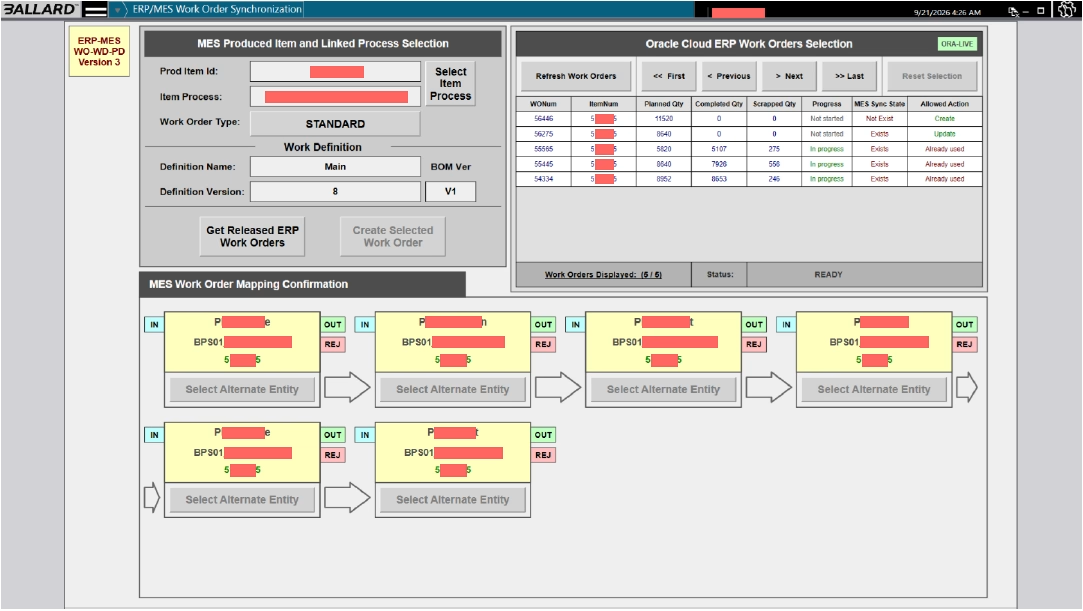
We developed a connectivity layer that allowed work orders to flow from Oracle into MES, where production teams could work with them directly on the shop floor. Material and inventory movements could be tracked digitally, while produced quantities, rejects, scrap, and other relevant production information could be reported back to the ERP. The operators could interact with the system through a single easy-to-use interface. For example, defective pieces and reasons for rejection could now be reported directly on the screens instead of relying on a lengthy and messy paper process. The system was now able to handle custom work orders that helped keep production smooth at all times.

The end goal was that production operates as one connected workflow – planning, material movement, production execution, and reporting moving as one. This is where the pilot moved beyond just being a pilot. It shaped up to be a strong and reliable digital foundation that could handle Ballard’s plans for expansion both in function and scale.

From pilot to platform through iterative development

Once the information was moving properly between the ERP and production, other fragmented workflows became visible. This is where our collaboration started to evolve from an integration project into a long-term development partnership. Over the following years, Ballard brought real production problems to the team rather than asking for generic MES modules. Where standard AVEVA functionalities fit, we used them. Where they didn’t, we adapted them or built something better suited to Ballard’s process.

That process was highly iterative. Ballard’s operations team would define a requirement, we would model and implement it, and the solution would be reviewed and adjusted before reaching production. The system therefore grew alongside Ballard’s manufacturing needs rather than following a predefined feature roadmap.

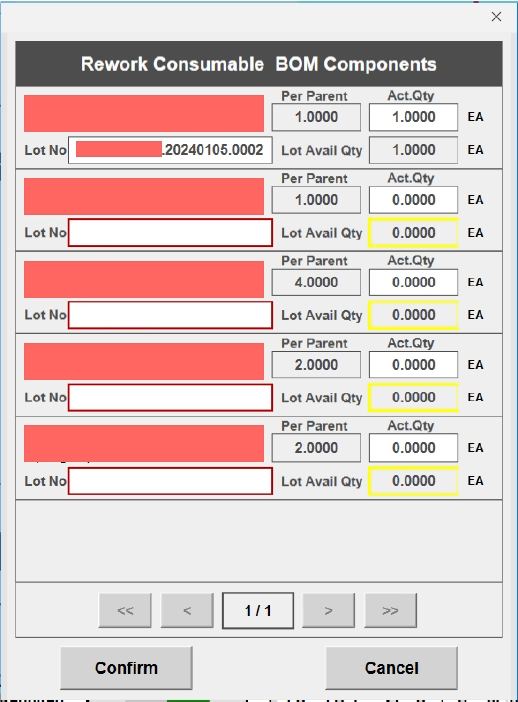
As the system expanded, we came across increasingly complex requirements and workflows – ones where basic out-of-the-box functionality wasn’t enough. A great example of this was the stack assembly/rework module. If testing identifies a problem inside an assembled stack, the affected component can be removed and replaced rather than discarding or treating the entire assembly as a whole. The MES therefore must retain the genealogy of the stack, record what was removed and what replaced it, and continue tracking the revised assembly through testing and subsequent production steps.

Stack assembly and rework became one of the more complex examples, but far from the only one. Over time, the MES expanded to support the following areas of Ballard’s production (in no particular order):

ERP-connected work order execution

Work orders are retrieved from the Oracle ERP directly into the MES. Production status, produced quantities, and other relevant information are then returned to the ERP in batches. Operators can now execute production directly from the MES instead of repeatedly moving manually between the two systems. Production information that previously required more than a week to synchronize gets there immediately or within minutes.

Erp Connected Work Order Execution

Production reporting

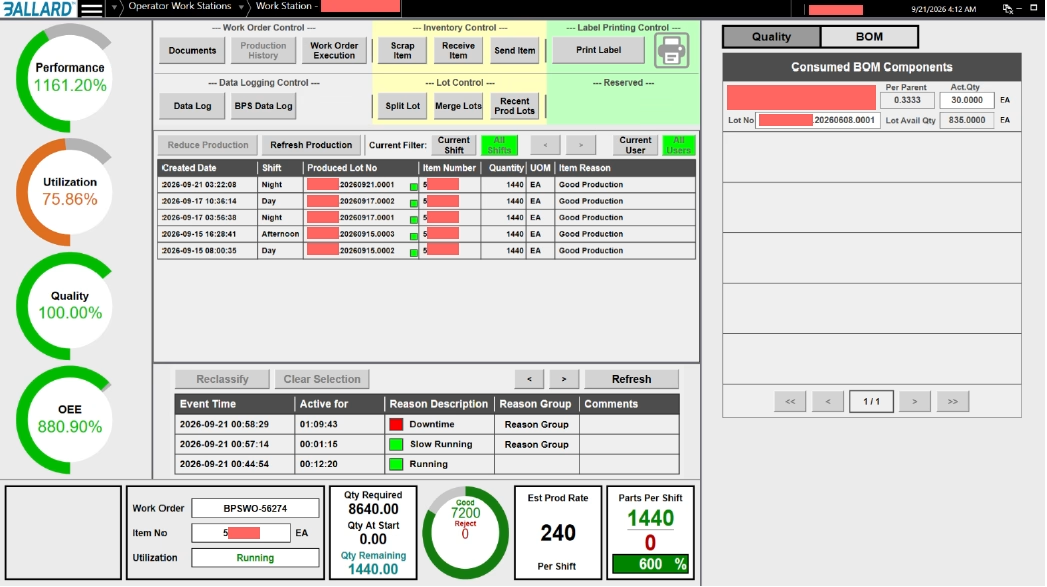
The MES now records produced quantities and communicates the results back towards the ERP. Operators can also digitally report good quantities, , and reasons for rejection. This completely replaced parts of the former manual paper workflow, now giving production and planning systems much faster visibility into actual output and losses.


Inventory and material management

Users can see available inventory, add inventory, move material between production stages, and record consumption. The location and status are digitally connected to production instead of requiring separate manual records, which maintains traceability as material moves through production.

Multiple work order types

The system now supports multiple types of work orders including orderless production and dedicated rework orders, which can contain only the operations required for that particular repair. This flexibility helps support different production situations instead of forcing every process into one model.

Operator Interfaces

Operator interfaces

The system consolidates previously fragmented functions into station-specific interfaces that give the operators the information and actions relevant to their current process. This reduces the need for operators to understand the systems operating behind the HMI and simplifies the production process.​

Digital work instructions

What was previously printed on a sheet of paper and taped to the machine itself, is now instantly available through the MES and can be directly associated with the relevant work order.

Label printing and reprinting

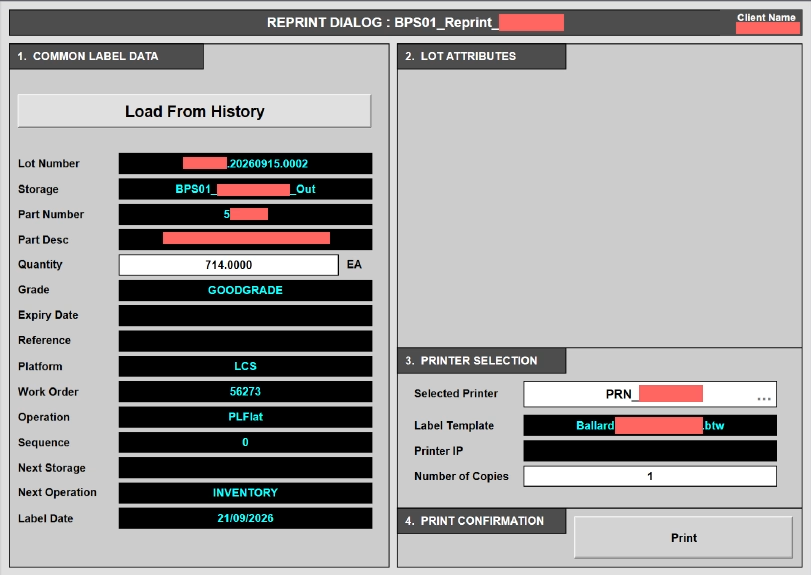
Industrial label printing was incorporated into the wider production workflow, with access to recent label prints, reprinting, and printer selection. It’s now handled through the production environment and makes recovery from a failed or damaged label considerably simpler.

Label Printing And Reprinting

Material and product traceability

The MES follows material and components through production and records how components become part of larger assemblies. This significantly improves persistent production genealogy instead of just providing a final production count.

Cell and stack assembly

A major custom functionality that represents complex assemblies and the components contained within them. It allows the MES to model the product’s actual structure instead of treating it as an indivisible product.

Testing And Rework

Testing and rework

Failed assemblies can now be rerouted back, individual components replaced, assemblies retested and the revisited genealogy retained. The complete change history remains traceable even when the physical product changes.

Exception handling and process control

The MES now also manages non-conforming materials through a quarantine functionality and rework flows. It verifies that required operations and approvals are complete before allowing production to continue and supports controlled rollback of incorrect transactions while keeping ERP data aligned. These exceptions are handled within a controlled digital workflow, reducing reliance on manual inputs and operator memory when things go wrong.

Ongoing improvements

The platform is still being consistently improved and extended when new processes and requirements appear. Ballard’s team is closely involved in this process, ensuring that the system conforms to their way of production instead of the other way around.

Results

Seven years after the original pilot, Ballard reports a 75% improvement in paperwork and manual data entry. Work orders, material movements, production quantities and exceptions are recorded directly in the MES, rather than passed through paper and spreadsheets. Operators access current production information and work instructions at their stations. Standardized workflows support consistent execution across shifts and production lines while reducing reliance on manual records and individual working methods.

Ballard also reports an 80% improvement in production reporting effort. With shop-floor activity captured in a shared system, production, planning, quality and maintenance teams work from a single, reliable source of production information. Production data that previously took weeks to reach Oracle ERP through manual reconciliation now arrives immediately or within minutes. This gives teams real-time visibility into production status and improves the timeliness and reliability of ERP records, so decisions can be based on current production information.

Material traceability and genealogy retrieval improved by 75%. Material and component histories remain accessible throughout production, testing and rework, including removal and replacement of components within fuel cell stacks. The MES preserves revised genealogy, verifies required quality checks and approvals, and provides controlled workflows for non-conforming material and corrections. Incorrect transactions can be corrected while maintaining alignment between MES and ERP records. These controls support consistent handling of deviations and greater confidence in production records.

Beyond these measured improvements, Ballard has greater control over how its MES evolves. Its technical team can troubleshoot and configure parts of the system, use MES data for its own reporting and participate in extending the platform, with INEA handling more complex development. This reduces dependence on the former closed integrator model and allows new workflows to be added as production requirements change. Together, standardized processes and accessible production data support continuous improvement.

CAD 100,000

saved


on the pilot line in one year.

75%

reduced

paperwork and manual data entry.

80%

more efficient


production reporting.

75%

better


material traceability and genealogy retrieval.

Quality control of plastic components using industrial vision and AI

Automated detection of cosmetic defects in complex plastic housing components using deep learning AI for precise surface quality control.

Improving data acquisition and OEE tracking with discrete MES in plastics manufacturing

Integrating MES with ERP system improved data acquisition and enhanced Overall Equipment Effectiveness (OEE) tracking for better production efficiency and planning.

Get in touch

Tell us about the challenges in your production environment and learn what’s possible. We will get back to you within 24 hours to set up a 30-minute discovery call.