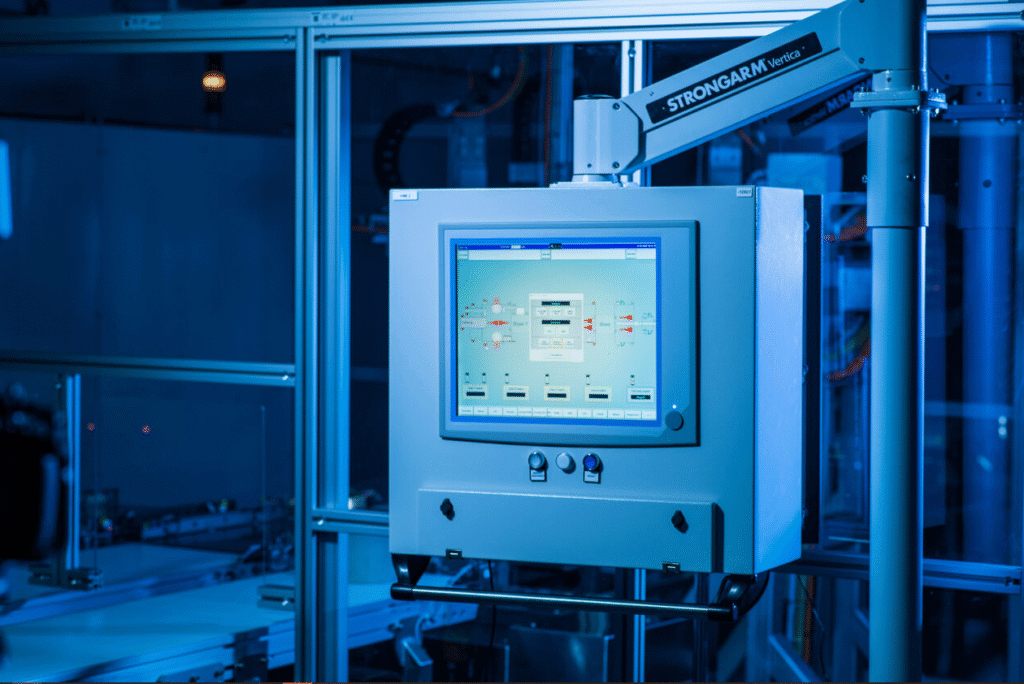
What is a Manufacturing Execution System?
Manufacturing Execution System (MES) is one of the key technologies in modern production. It is a comprehensive, dynamic software solution that monitors, tracks, documents, and controls the entire production process in real time.
By integrating with other business and production systems—such as ERP, APS, SCADA, and the supervisory control layer—MES provides a unified and coordinated view of manufacturing operations.
This enables increased efficiency, faster and more informed decision-making, regulatory compliance, and more effective quality management.

MES in manual and semi-automated production
In environments where production is based on manual operator work, MES improves productivity, consistency, and visibility of execution. It provides operators with real-time access to work orders, standard operating procedures (SOPs), and visual instructions—simplifying task execution and reducing the risk of errors.
The system captures key data from manual processes—including working time, workstation efficiency, and material consumption—and links it to quality outcomes and produced quantities. This data is used for advanced analytics, reporting, and process optimization.
Through integration with a Quality Management System (QMS), MES ensures that manually performed operations also meet traceability, compliance, and standardization requirements. The system supports full product genealogy, enabling complete traceability of materials used, operations performed, and operators involved – critical for highly regulated industries such as pharmaceuticals, food, and automotive.
Operators can interact with the MES using barcodes or 2D codes, touchscreens, or manual input – making the system effective even without automation. At the same time, it supports deviation alerts, enables faster decision-making by shift supervisors, and shortens response times.

Choosing the right MES licensing model
When implementing a Manufacturing Execution System, the licensing model you choose has a direct impact on cost, accessibility, and system flexibility. The model should reflect your production scale, number of users, shift structure, and budget. The two primary commercial models are:
Perpetual license: a one-time purchase that grants permanent usage rights. Support and upgrades are typically charged separately.
Subscription license: recurring monthly or annual payments that include access, updates, and technical support.
Beyond the commercial model, how licenses are technically allocated is equally important. This defines whether licenses are tied to users, devices, workstations, or shared dynamically across roles and functions.
Common licensing mechanisms
- Concurrent (floating) license – a set number of users can access the system at the same time. Ideal for multi-shift operations.
- Named user license – assigned to specific users, regardless of usage patterns.
- Transferable license – can be moved between users or devices, but not used simultaneously. Suitable for multi-site or low-frequency usage.
- Token-based (dynamic) license – distributes access flexibly across users and modules as needed. A good fit for multi-site setups or environments with frequent change.
- Modular or functional license – priced based on the specific MES modules or features you use. Your licensing model significantly influences the total cost of ownership (TCO) and your ability to scale or adapt the system over time.
Why perpetual licensing makes sense for manual and semi-automated production
In production environments that rely heavily on manual work or are only partially automated, perpetual MES licenses often provide the most cost-effective and future-proof option.
Here’s why:
Better economics with large workforces – In facilities with hundreds of operators, user-based subscriptions can become expensive fast. Licensing by workstation or using concurrent access keeps costs under control.
Access by station, not by user – In manual production, MES terminals are typically shared. Users log in at a station, not from personal devices, making named user models inefficient.
Stable costs, predictable TCO – Subscription pricing can rise over time due to added users, modules, or changes in terms. A perpetual license locks in long-term use and gives more control over total cost.
Less need for constant updates – Manual and semi-automated processes don’t change as frequently as fully automated systems, so the need for ongoing software updates is lower.
Qualifies for investment grants – Perpetual licenses are often considered capital expenditures (CapEx) and eligible for subsidies. Subscriptions, which are OpEx, typically are not.
Capitalizes long-term value – Perpetual licenses add to your company’s assets, while subscriptions do not. For accounting and long-term planning, that distinction matters.
For stable production environments with large operator teams and infrequent changes, perpetual MES licensing provides long-term savings and strategic control.
Perpetual License | Subscription License |
|
|---|---|---|
| Initial Cost | Higher upfront investment | Lower initial cost |
| Total Cost of Ownership (TCO) | Lower TCO after year 6 | Higher long-term TCO |
| Production Type | Manual or semi-automated production | Automated or semi-automated production |
| System Flexibility & Scalability | Suitable for stable, long-term production environments | Better for rapidly changing processes |
| Support & Updates | Requires separate maintenance agreements | Updates and support are included |
| Server Infrastructure | Requires on-premises infrastructure | Often hosted in the cloud (SaaS) |
| Cloud Services | Cloud option available | Cloud typically included |
| Capital Asset Value | Increases company’s capital assets | No impact on capital assets |
This chart compares two MES platforms under subscription and perpetual licensing. It shows cumulative total cost of ownership over time, including licenses, support and upgrades.

Choosing the right MES licensing model
For manufacturers operating in manual or semi-automated environments, a perpetual MES license often provides the best long-term return on investment (ROI). By eliminating recurring subscription costs, it offers greater stability and more predictable long-term budgeting.
On the other hand, subscription-based MES models offer greater scalability, easier cloud accessibility, and built-in updates – making them well-suited for startups, multi-site operations, or companies with dynamic production processes.
While many MES vendors are shifting toward subscription models to ensure predictable recurring revenue, these models can place a significant financial burden on manufacturers with large operator workforces and a high share of manual processes. Subscriptions offer flexibility, but they don’t fit all production profiles.
In practice, a hybrid approach often proves most effective – for example, using a perpetual license for core production operations, and subscription licenses for supervisory modules or mobile access points.
It’s also essential to consider how licenses are technically structured: whether they’re tied to the number of users, specific system functions, or concurrent usage. These mechanics can significantly impact cost-efficiency depending on the production setup.
By carefully analysing total cost of ownership (TCO), workforce size, required functionality, and long-term business goals, companies can choose a licensing model that not only reduces costs but also improves system productivity and operational stability. Ultimately, a well-chosen license model can be the difference between a cost-effective MES deployment and long-term budget overruns – especially in complex production environments.
As a long-standing MES integrator, we work with multiple leading vendors because we know that one-size-fits-all solutions don’t exist. An effective MES implementation only happens when the solution is aligned with the customer’s actual needs – both functionally and commercially. That’s why we provide vendor-neutral guidance when selecting licensing models that deliver the best long-term balance between cost and system performance.