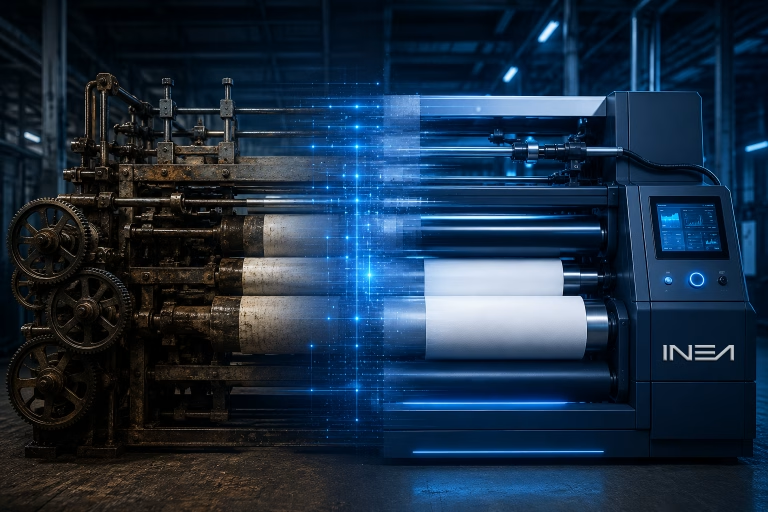
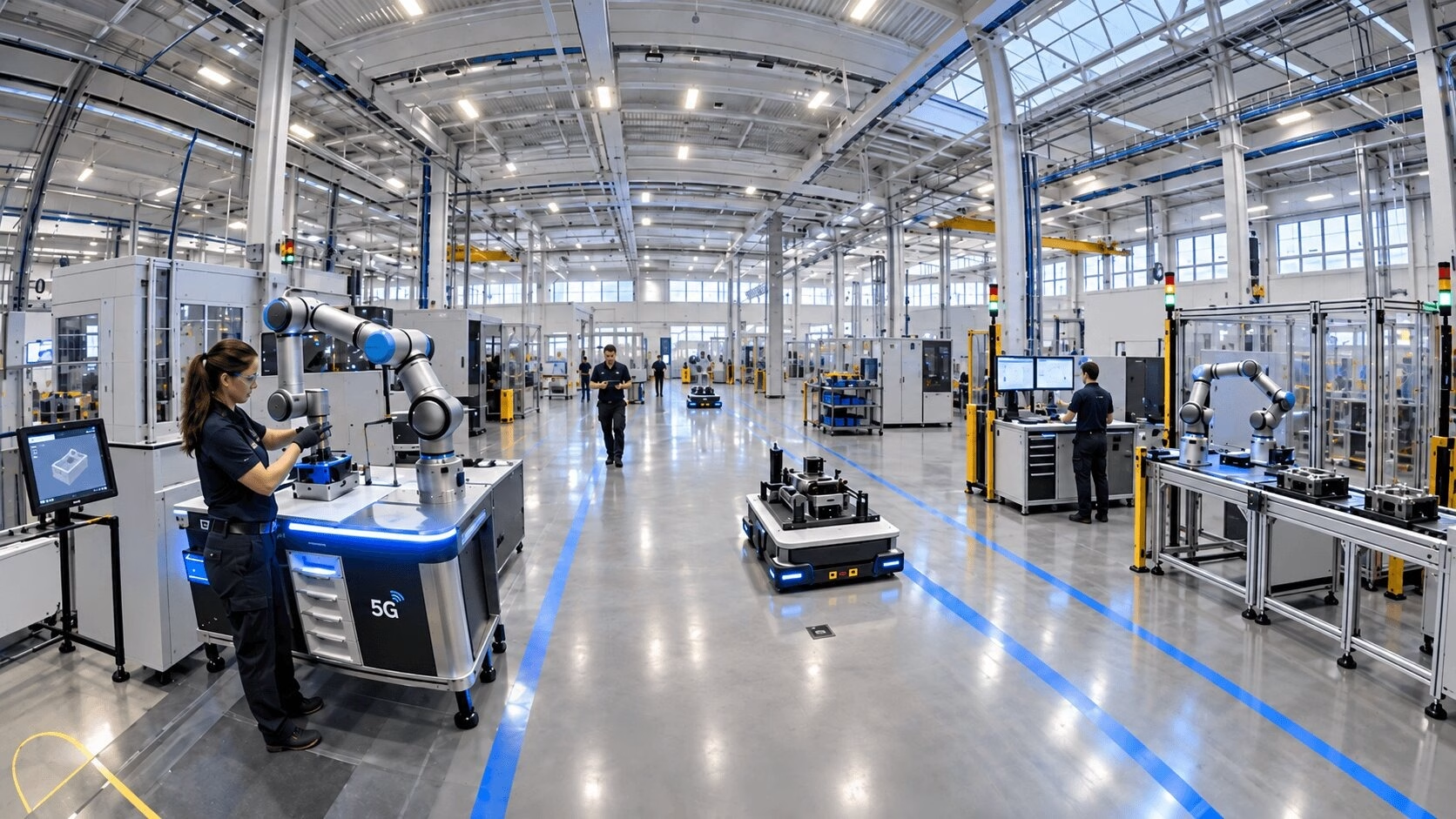
Already, more than a decade has passed since we’ve first started talking about digital transformation, computerisation, and industry 4.0 in manufacturing. The term was coined in 2011 at the Hannover Messe industrial trade fair and since then, integrators such as INEA have completed countless projects around the globe, merging physical machinery with digital technologies with the aim to create smart factories. AI generated imagery of factories loves to portray manufacturing as some space-age interconnected smooth-running cyber machine straight from a sci-fi movie. The operational reality though is much different than what LinkedIn would have you believe.
As an ongoing series on manufacturing data, today I’d like to uncover how that data actually travels around manufacturing facilities and why I think the whole industry still has a long way to go before coming close to the shiny connected cyber utopia it portrays itself to be. Let’s dive right into it.
The disconnected reality
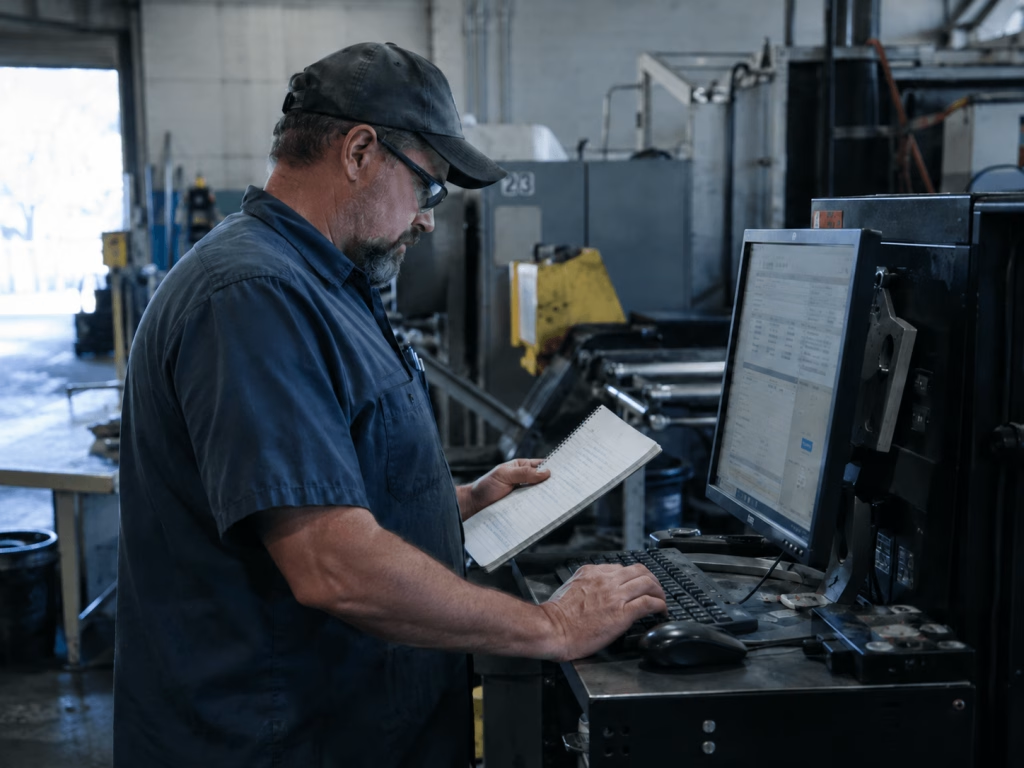
A particular image lives rent-free in my mind. A handwritten note with production data taped to a product, traveling around the factory floor like that’s completely normal. The funny thing? It really is completely normal. With all the talk of the digital revolution, one would think that that’s an image from 1966, but this is surprisingly endemic across manufacturing still in 2026. In fact, according to Gartner – 6 out of 10 manufacturers cannot see their data across sites without any manual consolidation. More concretely, their latest Smart Manufacturing Strategy and Implementation Trends Survey shows that key areas like equipment reliability and production scheduling can expect to reach only 59% automation by 2028.
In most cases, especially at lower digital maturity levels, manual data handling is seen as nothing more than “just how manufacturing works”. C-levels often label it as a departmental or functional problem instead of a business strategy problem until it blocks a major transformation initiative. Industry insights reveal it as a major profitability and competitive agility issue. Let’s look at how it secretly (or not so secretly) eats at profits and productivity.
The hidden or not so hidden consequences
We have already extensively talked about what good manufacturing data looks like in our “Self-assessment scorecard: From data-scarce to decision-ready“. We explicitly highlighted the five dimensions of good data: coverage, timeliness, accessibility, reliability, and context & standardisation. Manual data handling eats into most of these dimensions significantly. Let’s look at a concrete example, where our customer (Rotis) was struggling with efficient production planning due to reliance on manual data reconciliation.
The gist of this project was, that production planning relied on manual importing, exporting, and repairing of the plan. Although done with the help of technology such as tablets and laptops on the shop floor, the process was slow and thus not done on a regular basis. When a machine broke down or an employee was unexpectedly absent, adapting the production plan was difficult. The movement of information between systems couldn’t keep up with the demand. Although solved with a new APS implementation in the end, this was in essence a connectivity problem — humans doing the work of the integration layer.
You can read the full case study here: Read the case study.
We see this all too often. In another case, a customer already had a simple MES in place alongside the Oracle ERP. Both were doing their job, but data still had to be manually reconciled between different parts of production. That meant reporting could lag behind production by days or even weeks. While replacing the MES was paramount, the critical part of the solution was making the MES and the ERP communicate automatically. This got rid of manual data reconciliation which could now be done immediately or in regular automated batches.
Letting the cables do their work
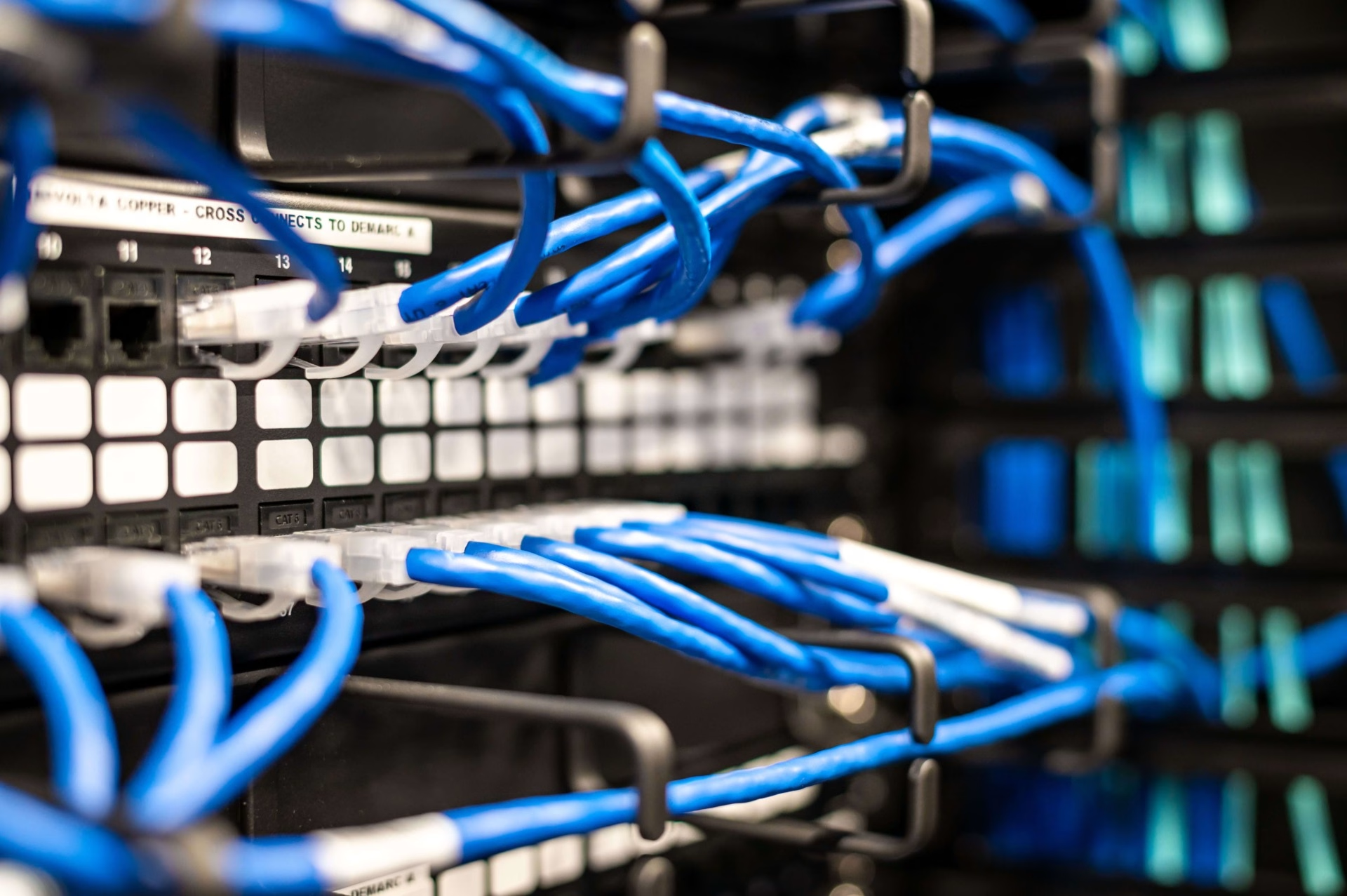
Manual data transfer is often one of the more straightforward digitalisation problems to identify. Connecting systems so that they exchange data automatically, whether over wired or wireless networks, does not solve every data problem, but it removes an unnecessary human handoff and creates several immediate benefits:
- Data moves between systems faster and is available sooner for decisions.
- The same values no longer need to be retyped, reducing the risk of transcription errors.
- Planning and reporting can work with a more current picture of production.
- Fewer manual handoffs mean fewer opportunities for information to be lost, changed, or forgotten.
- Replacing improvised transfers such as emailed spreadsheets or unsecured USB drives can also remove some data-governance and cybersecurity blind spots.
Most importantly, people can spend less time transporting information between systems and more time doing the work that actually requires their judgement and provides added value.
Finding the manual data streams
Before calling for help with manual data handling, you can do a simple check in your own manufacturing facility. The easiest way to find these problems is to follow the data. Pick one piece of information that really matters to production and trace it from its source and all along the way to its destination. Track where it goes and especially who gets to handle it along the way. Every time a person has to pull it out and put it in somewhere else ask one question: Are they adding information, or are they simply transporting that piece of data?
Once you find out whether that point of contact actually adds something to it and you’ll quickly see where the delays, duplicate entries, and unnecessary dependencies enter your data stream. With that information, you have a solid outline of your highest priority targets for a connectivity project.
Conclusion
There’s nothing inherently wrong with manual input. Sometimes you have to classify an event, confirm a reading, or add context that the machine can’t provide by itself. The problem arises when you handle data without adding anything to it. This is an expensive use of both your people and your data. It slows down production and introduces numerous new ways errors can enter your manufacturing data flow.
So, if you are still using people to move information from one system to another, it might be time to introduce some data cables to your shop floor.